Rust Learning basic

RUST Basic

Rust 程序设计语言 - Rust 程序设计语言 简体中文版 (kaisery.github.io)

Install

rustup 是一个管理 Rust 版本和相关工具的命令行工具

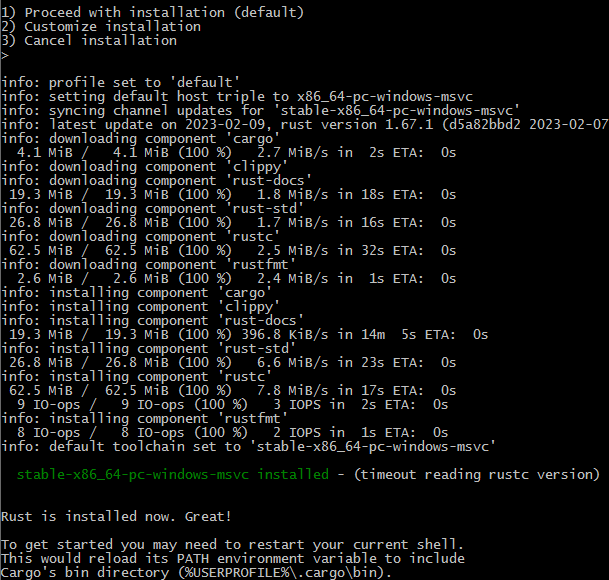
rust_install
rust_install

环境变量

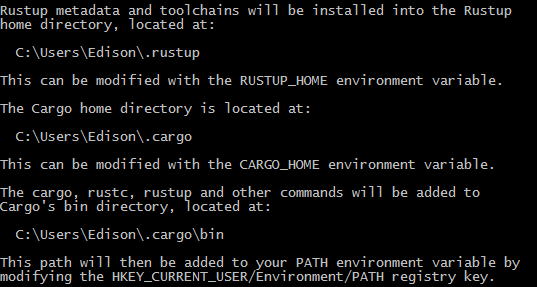
rust_env
rust_env

更新 $rustup update

安装状态 $rustc --version 输出 rustc 1.67.1 (d5a82bbd2 2023-02-07)

查看文档 rustup doc会自动使用默认浏览器打开安装的离线文档页面

Basic

  • 缩进使用4个空格,而不是一个tab
  • 调用的宏时,名字后有!,例如println!("hi human");
  • rust中的模块被称为crates
  • 使用snake case编程风格,所有字母小写并使用下划线分隔单词

编译

rust和c++一样是预编译静态类型语言

rustc .\main.rs

Cargo

Cargo是rust的构建系统和包管理器,可以自动下载依赖库,在使用rustup安装时一并安装到系统中。

创建一个项目执行

$cargo new cargo_demo

会自动创建一个src目录,一个.gitignore文件和Cargo.toml文件

Cargo使用TOML (Tom’s Obvious, Minimal Language) 格式作为项目配置文件

[package]以[]开始的是一个片段

  • 编译工程 在工程目录下执行cargo build,编译时间很长,生成的文件在target的debug目录下
  • cargo run编译并直接运行
  • cargo check代码检查
  • cargo build --release编译release版本
依赖

在Cargo.toml的[dependencies]添加依赖库crate,添加一个生成随机数的rand库,版本为0.8.5

1
2
3
4
5
6
7
[package]
name = "cargo_demo"
version = "0.1.0"
edition = "2021"

[dependencies]
rand = "0.8.5"

再次执行build后,会下载所有依赖的库,包括rand依赖的库

编译选项

在Cargo.toml中有三个段和对应的cargo命令相匹配,对应段的设置对对应的命令进行配置。

配置段 命令
[profile.dev] cargo build
[profile.release] cargo build –release
[profile.test] cargo test
例如在编译的release版本时,增加符号信息,可以在[profile.release]段下增加debug信息配置,同时不影响编译优化。
1
2
[profile.release]
debug = "limited"
Cargo.lock

工程中的Cargo.lock文件记录了第一次构建时,所有符合要求的依赖库版本,以后再次构建不会再去找依赖库的版本,方便今后“可重复构建”

如果没有修改工程配置,使用cargo update可以强制更新当前配置文件设置的最新库版本,例如更新到配置文件中指定的最新版本

如果修改了toml的配置文件,执行build时,就会下载最新的库文件。

依赖库离线打包

在工程设置好cargo.toml文件后,在工程的根目录执行cargo vendor,可以把当前工程的依赖库下载到工程根目录下的vendor目录中。

在工程的根目录中新建.cargo目录,并在其中新建config配置文件,配置以下内容让工程使用指定目录的依赖库程序

1
2
3
4
5
[source.crates-io]
replace-with = "vendored-sources"

[source.vendored-sources]
directory = "vendor"

把当前工程的整个目录拷贝到其他不能联网的机器,就会使用下载好的依赖库文件,同时也可以提高编译效率,不用每次都重新下载依赖库了。

文档

执行rustup doc --std可以在浏览器中打开本地离线的rust标准库文档

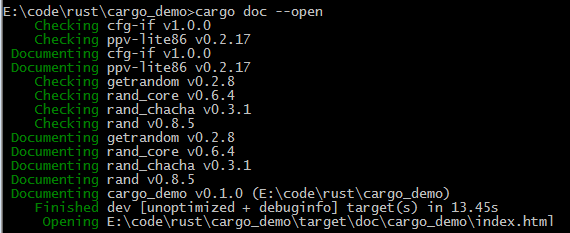
执行cargo doc --open可以构建本地依赖库的文档,并在浏览器中打开

cargo_doc
cargo_doc

示例程序1
1
2
3
4
5
6
7
8
9
10
11
12
13
14
15
16
17
18
19
20
21
22
23
24
25
26
27
28
29
30
31
32
33
use rand::Rng;
use std::cmp::Ordering;
use std::io;

fn main() {
println!("Guess my age!");

let my_age = rand::thread_rng().gen_range(1..=100);
loop {
println!("Input your guess: {my_age}");

let mut guess = String::new(); // mut 可变变量
io::stdin()
.read_line(&mut guess)
.expect("Failed to read line");

let guess: u32 = match guess.trim().parse() {
Ok(num) => num,
Err(_) => continue, // -是一个通配符,匹配所有Err值,如果不能转换为数字,进入下次循环
};

println!("You guessed: {guess}"); // {}占位符,可以打印变量或表达式结果

match guess.cmp(&my_age) {
Ordering::Less => println!("Small"),
Ordering::Greater => println!("Big"),
Ordering::Equal => {
println!("Right");
break;
}
}
}
}
示例程序2 - web server

Programming Rust 中的示例程序,使用最新的库使用异步方式,不能用书中的源代码

1
2
3
4
5
6
7
8
9
10
11
12
13
14
15
16
17
18
19
20
21
22
23
24
25
26
27
28
29
30
31
32
33
34
35
36
37
38
39
40
41
42
43
44
45
46
47
48
49
50
51
52
53
54
55
56
57
58
59
60
61
use actix_web::{web, App, HttpResponse, HttpServer};
use serde::Deserialize;

#[derive(Deserialize)]
struct GCDParameters {
a: u64,
b: u64,
}

fn gcd(a: u64, b: u64) -> u64 {
if b == 0 {
a
} else {
gcd(b, a % b)
}
}

async fn post_gcd(form: web::Form<GCDParameters>) -> HttpResponse {
if form.a == 0 || form.b == 0 {
return HttpResponse::BadRequest()
.content_type("text/html")
.body("Computeing the GCD error");
}

let response = format!("The result is <b>{} </b>\n", gcd(form.a, form.b));
HttpResponse::Ok().content_type("text/html").body(response)
}

#[actix_web::main]
async fn main() {
print!("start run");
let server = HttpServer::new(|| {
App::new()
.route("/", web::get().to(get_index))
.route("/gcd", web::post().to(post_gcd))
});

println!("Serving on http://localhost:3000");
server
.bind("127.0.0.1:3000")
.expect("error binding server to address")
.run()
.await
.expect("error running server");
}

async fn get_index() -> HttpResponse {
HttpResponse::Ok().content_type("text/html").body(
r##"
<title>GCD Calculator</title>
<h1>GCD Calculator</h1>
<form action="/gcd" method="post">
<label for="number1">Number 1:</label>
<input type="number" id="number1" name="a" required>
<label for="number2">Number 2:</label>
<input type="number" id="number2" name="b" required>
<button type="submit">Calculate</button>
</form>
"##,
)
}

对应的依赖

1
2
3
[dependencies]
actix-web = "4.9.0"
serde = { version = "1.0.228", features = ["derive"] }
示例程序3 - Mandelbrot Set

依赖

1
2
num = "0.4.0"
image = "0.25.0"

这个例子程序以图片中的像素点作为复数平面的点,其中实部为横坐标,虚部为纵坐标,计算每一个像素对应的复数是否在Mandelbrot集合中,如果在集合中这个像素点为纯黑色。

1
2
3
4
5
6
7
8
9
10
11
12
13
14
15
16
17
18
19
20
21
22
23
24
25
26
27
28
29
30
31
32
33
34
35
36
37
38
39
40
41
42
43
44
45
46
47
48
49
50
51
52
53
54
55
56
57
58
59
60
61
62
63
64
65
66
67
68
69
70
71
72
73
74
75
76
77
78
79
80
81
82
83
84
85
86
87
88
89
90
91
92
93
94
95
96
97
98
99
100
101
102
103
104
105
106
107
108
109
110
111
112
113
114
115
116
117
118
119
120
121
122
123
124
125
126
127
128
129
130
131
132
133
134
135
136
137
138
139
140
141
142
143
144
145
146
147
148
149
150
151
152
153
154
155
156
157
158
159
160
161
162
163
164
165
166
167
168
169
170
171
172
173
174
175
176
177
178
179
180
181
182
183
184
185
186
187
188
189
190
191
192
193
194
195
196
197
198
199
200
201
202
203
204
205
206
207
208
209
210
211
212
213
214
215
216
217
218
219
220
221
222
223
use num::Complex;

/// Try to determine if `c` is in the Mandelbrot set, using at most `limit`
/// iterations to decide.
///
/// If `c` is not a member, return `Some(i)`, where `i` is the number of
/// iterations it took for `c` to leave the circle of radius 2 centered on the
/// origin. If `c` seems to be a member (more precisely, if we reached the
/// iteration limit without being able to prove that `c` is not a member),
/// return `None`.
fn escape_time(c: Complex<f64>, limit: usize) -> Option<usize> {
let mut z = Complex { re: 0.0, im: 0.0 };
for i in 0..limit {
// z距离原点的平方大于4
if z.norm_sqr() > 4.0 {
// 迭代了多少次这个复数出了集合,以这个次数会灰度绘图,例如超过了255次还在集合内,就绘制黑色
return Some(i);
}
z = z * z + c;
}

None
}

use std::str::FromStr;

/// Parse the string `s` as a coordinate pair, like `"400x600"` or `"1.0,0.5"`.
/// 分割命令行参数中的组合参数
/// Specifically, `s` should have the form <left><sep><right>, where <sep> is
/// the character given by the `separator` argument, and <left> and <right> are
/// both strings that can be parsed by `T::from_str`. `separator` must be an
/// ASCII character.
///
/// If `s` has the proper form, return `Some<(x, y)>`. If it doesn't parse
/// correctly, return `None`.
fn parse_pair<T: FromStr>(s: &str, separator: char) -> Option<(T, T)> {
match s.find(separator) {
None => None,
Some(index) => {
// match 的参数类型可以是元组类型
match (T::from_str(&s[..index]), T::from_str(&s[index + 1..])) {
(Ok(l), Ok(r)) => Some((l, r)),
_ => None,
}
}
}
}

#[test]
fn test_parse_pair() {
assert_eq!(parse_pair::<i32>("", ','), None);
assert_eq!(parse_pair::<i32>("10,", ','), None);
assert_eq!(parse_pair::<i32>(",10", ','), None);
assert_eq!(parse_pair::<i32>("10,20", ','), Some((10, 20)));
assert_eq!(parse_pair::<i32>("10,20xy", ','), None);
assert_eq!(parse_pair::<f64>("0.5x", 'x'), None);
assert_eq!(parse_pair::<f64>("0.5x1.5", 'x'), Some((0.5, 1.5)));
}

/// Parse a pair of floating-point numbers separated by a comma as a complex
/// number.
fn parse_complex(s: &str) -> Option<Complex<f64>> {
match parse_pair(s, ',') {
Some((re, im)) => Some(Complex { re, im }),
None => None,
}
}

#[test]
fn test_parse_complex() {
assert_eq!(
parse_complex("1.25,-0.0625"),
Some(Complex {
re: 1.25,
im: -0.0625
}),
);
assert_eq!(parse_complex(",-0.0625"), None);
}

/// Given the row and column of a pixel in the output image, return the
/// corresponding point on the complex plane.
/// 把一副图片中的一个像素点转换为复数
/// `bounds` is a pair giving the width and height of the image in pixels.
/// `pixel` is a (column, row) pair indicating a particular pixel in that image.
/// The `upper_left` and `lower_right` parameters are points on the complex
/// plane designating the area our image covers.
fn pixel_to_point(
bounds: (usize, usize),
pixel: (usize, usize),
upper_left: Complex<f64>,
lower_right: Complex<f64>,
) -> Complex<f64> {
let (width, height) = (
lower_right.re - upper_left.re,
upper_left.im - lower_right.im,
);
Complex {
re: upper_left.re + pixel.0 as f64 * width / bounds.0 as f64,
im: upper_left.im - pixel.1 as f64 * height / bounds.1 as f64,
// Why subtraction here? pixel.1 increases as we go down,
// but the imaginary component increases as we go up.
}
}

#[test]
fn test_pixel_to_point() {
assert_eq!(
pixel_to_point(
(100, 200),
(25, 175),
Complex { re: -1.0, im: 1.0 },
Complex { re: 1.0, im: -1.0 },
),
Complex {
re: -0.5,
im: -0.75
},
);
}

/// Render a rectangle of the Mandelbrot set into a buffer of pixels.
///
/// The `bounds` argument gives the width and height of the buffer `pixels`,
/// which holds one grayscale pixel per byte. The `upper_left` and `lower_right`
/// arguments specify points on the complex plane corresponding to the upper-
/// left and lower-right corners of the pixel buffer.
fn render(
pixels: &mut [u8],
bounds: (usize, usize),
upper_left: Complex<f64>,
lower_right: Complex<f64>,
) {
assert!(pixels.len() == bounds.0 * bounds.1);

for row in 0..bounds.1 {
for column in 0..bounds.0 {
// 逐行计算每一个像素点在多少次计算后不在集合中
let point = pixel_to_point(bounds, (column, row), upper_left, lower_right);
pixels[row * bounds.0 + column] = match escape_time(point, 255) {
None => 0,
Some(count) => 255 - count as u8, // 如果255轮计算后还在集合,就为黑色,黑色的值为0
};
}
}
}

use image::codecs::png::PngEncoder;
use image::{ExtendedColorType, ImageEncoder, ImageError};
use std::fs::File;

/// Write the buffer `pixels`, whose dimensions are given by `bounds`, to the
/// file named `filename`.
fn write_image(filename: &str, pixels: &[u8], bounds: (usize, usize)) -> Result<(), ImageError> {
let output = File::create(filename)?;

let encoder = PngEncoder::new(output);
encoder.write_image(
pixels,
bounds.0 as u32,
bounds.1 as u32,
// 灰度图像
ExtendedColorType::L8,
)?;
Ok(())
}
use std::env;
use std::time::Instant;

fn main() {
// 可以使用PowerShell的measure-command计算程序执行时间
// On Windowsin PowerShell: measure-command {.\target\debug\cargo_demo.exe mandel.png 4000x3000 -1.20,0.35 -1,0.20 true}.
let args: Vec<String> = env::args().collect();

if args.len() != 6 {
let program = &args[0];
eprintln!("Usage: {program} FILE PIXELS LEFT,TOP RIGHT,BOTTOM USE_THREADS");
eprintln!("Example: {program} mandel.png 1000x750 -1.20,0.35 -1,0.20 true");
std::process::exit(1);
}

let start = Instant::now();
let bounds: (usize, usize) = parse_pair(&args[2], 'x').expect("error parsing image dimensions");
let upper_left = parse_complex(&args[3]).expect("error parsing upper left corner point");
let lower_right = parse_complex(&args[4]).expect("error parsing lower right corner point");

let mut pixels = vec![0; bounds.0 * bounds.1];
let b_use_threads = args[5].parse::<bool>().unwrap_or(false);
println!("use threads {}", b_use_threads); // 我的5600 CPU是12个线程
if !b_use_threads {
render(&mut pixels, bounds, upper_left, lower_right);
} else {
let threads = std::thread::available_parallelism()
.expect("error querying CPU count")
.get();
println!("threads count is {}", threads);
let rows_per_band = bounds.1.div_ceil(threads);

let bands = pixels.chunks_mut(rows_per_band * bounds.0);
std::thread::scope(|spawner| {
for (i, band) in bands.enumerate() {
let top = rows_per_band * i;
let height = band.len() / bounds.0;
let band_bounds = (bounds.0, height);
let band_upper_left = pixel_to_point(bounds, (0, top), upper_left, lower_right);
let band_lower_right =
pixel_to_point(bounds, (bounds.0, top + height), upper_left, lower_right);
// 每个线程处理图片的250行,并发进行,充分利用CPU资源
println!("thread {} start and band top {}.", i, top);
spawner.spawn(move || {
render(band, band_bounds, band_upper_left, band_lower_right);
});
}
});
}

write_image(&args[1], &pixels, bounds).expect("error writing PNG file");

let duration = start.elapsed();
println!("Time elapsed in seconds: {}", duration.as_secs());
println!("Time elapsed in milliseconds: {}", duration.as_millis());
println!("Time elapsed in nanoseconds: {}", duration.as_nanos());
}

多线程使用时间为9s,不使用多线程需要41s。生成图片如下,这个图片局部放大后的形状都是相似的葫芦形,数学的魅力。

mandelbrot_set
mandelbrot_set

基本语法

变量

变量默认是不可改变的immutable,一旦一个值绑定到了一个变量上,就不能改变这个变量的值。

如果修改一个不可变变量的值,会有这个错误:error[E0384]: cannot assign twice to immutable variable game
不可变变量的好处:

  • 并发程序在编译时避免多线程问题?

定义可变变量需要使用mut关键字,虽然可以修改变量的值,但是不能更改变量的数据类型

1
let mut game = "cod";

常量

常量是固定不可变的,使用const关键字,常量可以在任何作用域声明,必须是表达式,不能在运行时计算出值。

1
const SECONDS_OF_DAY: u32 = 24*60*60;

隐藏(shadowing)

可以定义一个和之前变量同名的新变量,前一个变量会被隐藏,当第二个变量退出自己的作用域后,变量会恢复第一个变量的值。隐藏是新建了一个变量,并不是改变原来变量的值,和mut完全不同。

1
2
3
4
5
6
let game = "cod";
{
let game = "halo";
println!("The best FPS is {game}"); //halo
}
println!("The best FPS is {game}"); // cod

数据类型

标量(scalar)

表示单独的一个数值

  • 整型:u8, i8(-128~127), u16, i16, u128, i128, usize, isize和程序架构绑定。变量赋值时,可以使用数据类型来指定类型,例如56u8指定数据类型为u8,数字之间可以使用下划线_分隔方便读数,如5_600表示5600.
  • 数字类型表示:十六进制(hex) 0xFF; 八进制(Octal) 0o77; 二进制(binary) 0b1111_0000; 字节(仅能用于u8) b’A’
  • 整数溢出:例如给一个u8类型变量赋值256时,debug版本会出现panic错误,release版本会给变量赋值为 0,257赋值为1进行回绕。标准库提供了检查溢出的方法例如overflowing_*
  • 浮点型:f32, f64,默认为f64。使用IEEE-754标准
  • 布尔型:bool 两个值truefalse
  • 字符类型:char 占4个字节,代表一个Unicode标量值。范围U+0000~U+7DFFU+E000~U+10FFFF在内的值。
复合类型(Compound types)

将多个值组合成一个类型

元组类型

元组长度固定,一旦声明,长度不能改变。元组中的每一个位置的数据类型可以是不同的。可以使用模式匹配来解构(destructure)元组值。也可以使用元组变量名加.索引的方式获取值。

1
2
3
4
5
let tup: (i32, f64, u8) = (500, 3.6, 1);
let (x, y, z) = tup; // destructuring
let x = tup.0;
println!("The value of x is : {x}");
println!("The value of y is : {y}");

没有任何值的元组称作单元(unit),表示空值或空的返回类型。

数组类型

数组中每个元素的数据类型相同,且长度固定。

1
2
3
4
let food = ["breakfast", "lunch", "supper"];
let data:[i32; 3] = [1, 2, 3];
let data = [6, 3]; // [6, 6, 6]
let num = data[0];

函数

函数声明使用fn关键字开始,每个参数必须声明类型,在函数参数列表后使用->指明函数的返回类型

1
2
3
4
5
6
7
fn cal_price(val: f64, fac: f64) -> f64  {
let price = val*fac;
println!("The deal price is {price}");
price // return a expression as return value
}

let price = cal_price(21.5, 1.25);

rust的编译器只会推断函数体内变量的类型,函数的参数和返回值的类型必须要声明写出来。

rust的典型函数实现中会用表达式返回函数的返回值,return只在需要在函数体内提前返回值的情况。

表达式

语句(statements) 是执行一些操作但不返回值的指令

表达式(Expressions) 计算并产生一个值,表达式结尾没有分号

在C++中表达式和语句有明确区分,ifswitch这种代码段称为语句, 这样的5*(f-32)/9称为表达式,表达式有值,而语句不会产生值,也不能放在表达式中间。

rust是表达式语言。它的ifmatch表达式都会产生值。例如可以使用match作为参数

1
2
3
4
5
6
7
8
let length = 100;
println!(
"Use match expression value {}",
match length {
100 => "hello world",
_ => "",
}
);

所以rust中不需要c++里面的三元运算符(expr1 ? expr2:expr3),rust里面直接使用let表达式就行了。

代码块表达式block expression:对于使用{ }包围的代码块,它的最后一个表达式就是这个代码块的最终值。如果一个代码块的最后一行代码以;结束,它的值为()

控制流

条件表达式

if后跟一个条件,和其他语言类似,这个条件必须返回bool类型的值。if表达式可以给let赋值。如果if语句没有else,那么它必须返回()即最后一行语句要以;结束。否则rust编译器会提示if` expressions without `else` evaluate to `()

1
2
3
4
5
6
7
8
9
10
11
   let number = 255;
if number > 255 {
println!("greater than 255");
} else if number == 0 {
println!("nonsense");
} else {
println!("less than 255 except 0");
}
// 这种情况下的所有分支返回的数据类型必须相同,否则编译器无法确定num的类型
// 每一个分支中都是一个表达式,数字后面没有分号结束。
let num = if number > 50 { 100 } else { 0 };
循环
loop

无条件的循环执行,除非执行了break或程序中断。可以在loop循环的break语句中返回值。

1
2
3
4
5
6
7
8
let mut counter = 0;
let result = loop {
counter += 1;
if counter >= 10 {
break counter * 5;
}
};
println!("The last counter is {result}");
循环标签

循环标签可以给一个循环指定一个名字,默认情况下break和continue作用于此时最内层的循环,使用标签可以让他们作用于指定的循环。标签使用单引号作为开始.

1
2
3
4
5
6
7
8
9
10
11
12
13
14
15
16
17
18
19
let mut counter = 0;
'count_up: loop {
counter += 1;
println!("counter = {counter}");

let mut remain = 10;

loop {
println!("remain = {remain}");
if remain < 5 {
break; // 只跳出remain的循环
}
if counter == 10 {
break 'count_up; // 跳出外层循环
}
remain -= 1;
}
};
println!("The last counter is {counter}");
while

while和其他语言相同,条件为true执行循环

1
2
3
4
while counter < 10 {
counter += 1;
println!("counter = {counter}");
}
for

使用for x in seq的方式遍历数组

1
2
3
4
5
6
7
8
let food = ["breakfast", "lunch", "supper"];
for meal in food {
println!("Eat at {meal}");
}

for number in (1..3).rev() { // 左闭右开,rev()反转序列
println!("Eat time {number}");
}
匹配
match表达式

由多个分支组成,类似switch语句。每个分支包含一个模式和表达式,表达式以,结尾。

match的每个分支的表达式就是match的返回值,所以分支表达式的数据类型需要相兼容。

match必须用分支覆盖所有的情况,否则会编译错误,可以使用通配符匹配所有其他情况,这个通配符可以看作一个变量名,它匹配所有的其他相同类型的值,我们可以在这个分支的表达式中使用这个匹配变量,也可以使用_匹配任意值,但是我们不会引用它的值,可以看作是default。

模式的匹配是按编写顺序执行,所以不能把通配符分支放在前面,这样后面的分支无法被匹配。

1
2
3
4
5
match value {
patten1 => expression1,
patten2 => expression2,
patten3 => expression3,
}

在匹配的分支中可以使用模式的部分值。

1
2
3
4
5
6
7
8
9
10
11
12
13
14
15
16
17
18
19
20
21
22
23
24
25
26
27
28
29
30
31
32
33
34
35
36
37
38
39
40
41
42
43
44
45
46
#[derive(Debug)]
enum Message {
Quit,
Move { x: i32, y: i32},
Write(String),
ChangeColor(i32, i32, i32),
}
fn handle_message(msg: Message) {
println!("match start");
match msg {
Message::Quit => println!("Quit"),
Message::Write(val) => {
println!("write {}", val);
}
Message::Move { x, y } => {
println!("move pos {},{}", x, y);
}
Message::ChangeColor(r, g, b) => {
println!("change color {},{},{}", r,g,b);
}
}
println!("match end");
}

let move_msg = Message::Move { x: 15, y: 20 };
handle_message(move_msg);

fn plus_one(x: Option<i32>) -> Option<i32> {
match x {
None => None,
Some(i) => Some(i+1),
}
}

let roll = 100;
match roll {
5 => println!("luck num:{roll}"),
10 => println!("bad num:{roll}"),
left => println!("norm num:{left}"),// left是通配符
}

let config_max = Some(3u8);
match config_max {
Some(max) => println!("The max is {max}"),
_ => (), // 匹配所有其他值,但是不需要引用,这样没有编译警告,写法简单
}
if let表达式

如果只关系一种匹配的情况,而忽略其他match的分支时,可以使用if let简化match的写法。

1
2
3
4
5
6
7
let config_max = Some(3u8);
let config_none: Option<u8> = None;
if let Some(max) = config_max { // Some(max)等同于match中的模式
println!("The max is {max}"); // The max is 3
} else {
println!("None is input");
}
0%